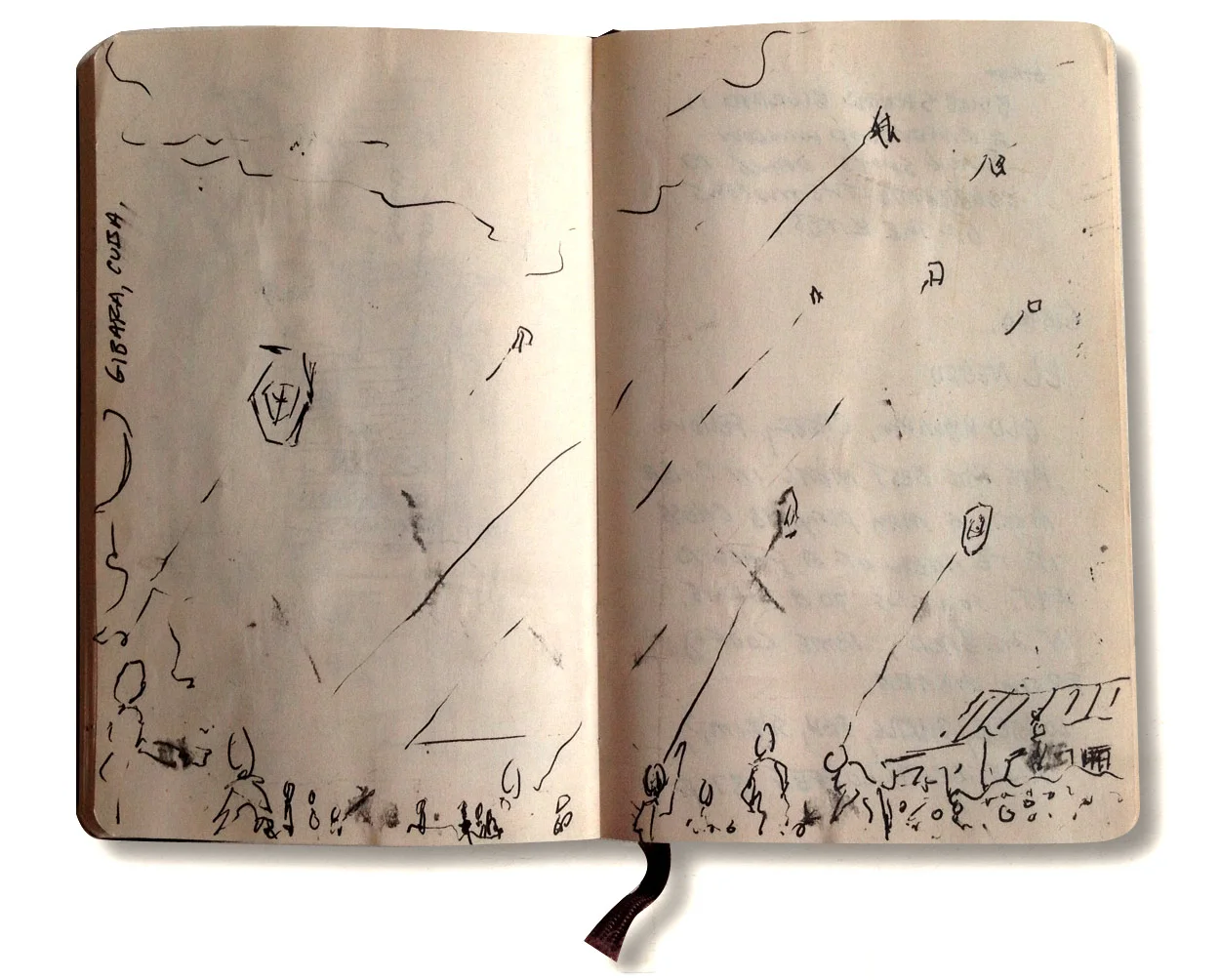
Walking down the mountain through the cloud, we see tucked inside the edge of road a man standing motionless in the mist holding a bucket, an ominous distant figure faded into the grey of the lush background. We are 7 intrepid travelers, coming down from the La Gran Peidra Mountain lookout in Santiago de Cuba. We joke that the man is the foreshadowing of a character from a horror movie. The stranger who will rampage through the house of the abandoned coffee plantation we are about to enter. We laugh and tease each other about who will be the first to be chopped up into little gory bits. We agree that it will probably be one of our translators, a lovely Cuban woman named Adriana, who eventually walks off by herself to go to the bathroom. Always the first victim.
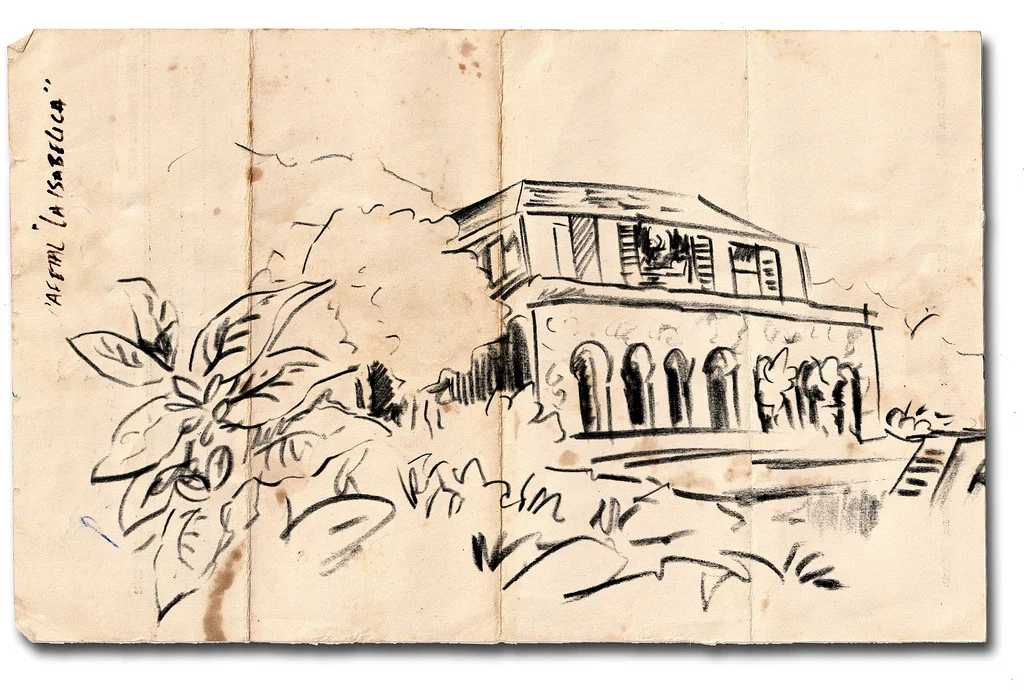
The leaves of the forest trail part to reveal a large white stone dance floor, a hector in size, on which millions of coffee beans were dried nearly 150 years ago. This is the entrance to Cafetal La Isabelica, a 18th century coffee farm opened by a French immigrant who fled Haiti. At the far end, a pyramid step rises up one level to the ground level of a building, its foundation stands 15 feet high, like the walls of an ancient fortress, made of limestone, rock and rough cement. It ages in the wet forest, allowing itself to be painted with patches of rust and moss. Atop the moat of stone and wall is a simple ranch house sitting low into the foundation, dwarfed by the construction forged around it. Someone mentions it looks like a set from the movie “Apocalypto” Mel Gibson’s movie about sacrificial ritual life in the ancient Aztec world.
The site is empty, save for the few of us who made the long walk. A Spanish-only speaking guide starts the tour, and we enter the first room. It is dark and cold, a 12x20 foot dungeon, floor to ceiling stocked with dozens of neatly arranged axe heads, hooks and other violent instruments of coffee farming designed to hack and pry the small bean from the safety of it’s home in the plant. In the center of the musty room sits a long wooden table, worn, ground, chipped, and pounded through years of use. We stroll under the twisted, ominously hanging metal hooks used for oil lanterns and laugh about the place being a proper torture chamber for our grim college slasher movie, poking the sharp macabre objects and shuddering playfully.
The guide walks us through the next room under the house, the storage room, where the coffee was stored. She points and blabbles on in Spanish too “rapido” for me to understand properly. I pick up odd bits about how the gaps in the wall were for the cats to enter and control the mice. In the far end of the room stands a tall wooden box with a crank that was used to separate the beans from the husks. The next room is where they kept the transportation items needed by a small coffee grower to move coffee up and down the mountain. Again, the twisted metal items hang along the walls, rusting in their spot after 150 years of abandonment, a wagon wheel, some horse fittings, odd twisty objects I do not have patience or the curiosity to ask about. Conspicuously, in the center of the room we see a rough hole hacked into the stone floor, no more than two feet in diameter and a foot deep. Our translator, listens to the guide and his face contorts as he turns to us to explain in broken English: “She say, that is a hole made for the belly of the pregnant women who made to lie on the ground while they were whipped.”
I’ve been to castles in Europe and have managed to site-see many of the gruesome instruments humans have invented for forced compliance, the iron maiden, the rack, the thumbscrew, cobbling tables, the list goes on throughout history. They never seem real. We curiously investigate each one as if it was from a macabre storyteller’s show and tell. Faded objects from the pages of a crinkly textbook, until I stood there, in the cool air of the stony room on a cloudy Cuban mountain staring at a hole abruptly chopped into the floor, I had never been quite as mortified. There in this little room, a man whipped a woman who was expecting a baby. Her blood staining the floor, and her screams amplifying through the house by the empty stone chamber.
There is the naive modern westerner in me that held on to the belief that even in the world of systematic cruelty, there should be rules. Torture chambers are made for dissidents, rebels, enemies, prisoners. Innocents aren’t supposed to be held in the yoke of sadism. Punishing an expectant mother surely has to be the last frontier of human degradation. Terrible things have happened in the pursuit of power, even to mothers, but to create a process for it, one designed to hurt the mother and yet keep the baby healthy so that it survives to become one of the labor force.
That was a very harsh reality.
I wish I could say that this was a behavior from a distant past, that this form of cruelty and barbarism have disappeared into our history and could only be found in modern slasher movies for our entertainment, but it’s still there for many workers in the world. Slavery was not abolished with the signing of Lincoln’s pen. All over the world there are miners, farmers, factory workers in countless nations, even our own. Their blood is in our goods, our chocolate, our tech products, just as it was in our coffee 150 years ago. The world may have moved on from the iron maiden and the monstrous cinematic killing machines of old Europe. But is there anything truly more terrifying than the darkness of humanity represented by the grisly simplicity of a man, a whip, and a hole in the floor?